
The Present as Unspent State
A UTxO-Inspired Model of Reality, Agency, and Social Action
A proposed conceptual framework for understanding the present moment (“now”) as a collection of unconsumed outputs from prior actions. Inspired by the Unspent Transaction Output (UTxO) model used in distributed ledger systems, particularly Cardano, the paper reframes reality itself as a state machine composed of available commitments, resources, and consequences awaiting consumption by future actions.
This framing provides a precise, non-mystical way to reason about agency, responsibility, social contracts, harm minimisation, and governance in both digital and human systems—especially under conditions of AI-driven scale and automation.
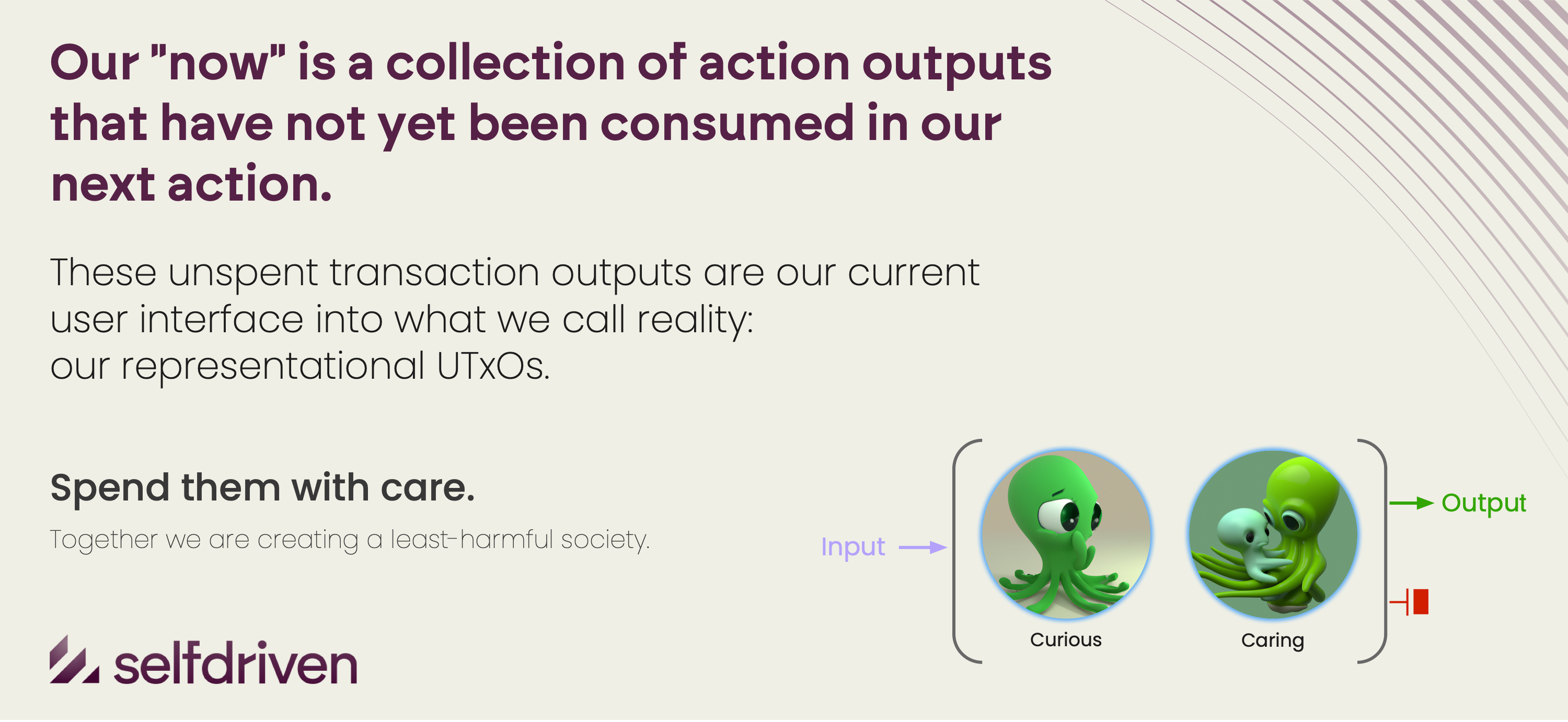
1. Reframing “Now”
The present is not a flowing instant or a metaphysical moment.
It is:
The final collection of action outputs that have not yet been consumed by our next action.
Every action—human or institutional—produces outputs:
- obligations
- permissions
- resources
- signals
- trust
- harm
- opportunity
At any given moment, we exist inside the set of outputs that remain available.
That set is the present.
2. Reality as Unspent State
In the UTxO model:
- transactions consume existing outputs
- and produce new outputs
- state is not mutated, only replaced
In lived reality:
- actions consume prior conditions
- and create new ones
- the world advances by state transition, not revision
We therefore define:
Unspent Reality Outputs (UROs)
The set of conditions produced by past actions that are still available to be acted upon.
Examples include:
- legal rights and obligations
- institutional authority
- environmental conditions
- social trust
- reputational standing
- emotional and relational residue
This collection is our interface to reality.
3. Representational UTxOs
Humans cannot directly perceive full reality state.
Instead, we operate through representations:
- credentials
- documents
- contracts
- identities
- records
- narratives
These are representational UTxOs.
They do not create reality.
They make specific parts of it legible, verifiable, and spendable.
4. Action as Consumption
An action is never neutral.
To act is to:
- consume some subset of available outputs
- invalidate alternative futures
- produce new outputs in their place
Responsibility therefore lies not in intention, but in selection.
- You are not responsible for all possible states.
- You are responsible for which unspent outputs you choose to consume.
Ethics becomes a question of state transition quality.
5. Social Contracts as Validators
In distributed systems, transactions are validated against rules.
In society, actions are validated against:
- law
- norms
- care
- context
- consequences
Each actor carries an implicit core validator.
In this model:
- Curiosity enables exploration and learning
- Care constrains action to minimise harm
Together they form a minimal social validator:
- Is this action justified?
- Does it avoid unnecessary harm?
Validation must occur before execution, not after damage.
6. “Spend Them With Care”
The present is finite.
You cannot:
- re-spend trust once consumed
- undo harm already propagated
- recover time already burned
Spend unspent reality outputs with care.
This is not moralising.
It is a system design constraint.
Careful spending preserves optionality.
Reckless spending collapses futures.
7. Toward Least-Harmful Societies
A least-harmful society is not conflict-free.
It is one where:
- state is explicit
- responsibility is attributable
- validation is ex-ante
- harm is measurable and constrained
UTxO-like thinking enables:
- scalable coordination
- clear accountability
- automation without ambiguity
8. Policymaker Summary (Short Form)
The Core Idea
At any moment, governance operates on the outcomes of past decisions that have not yet been acted upon.
These include:
- public trust
- legal obligations
- infrastructure
- environmental conditions
- institutional authority
This collection of available outcomes is what policymakers actually govern.
Why It Matters
Modern systems fail because:
- actions lack traceable accountability
- evidence is ambiguous
- harm is detected too late
- AI accelerates failure modes
Policy Implication
Governance should focus on validating state transitions, not managing processes.
This means:
- making outcomes explicit
- attaching responsibility to actions
- validating decisions before execution
This enables fairness, transparency, and harm minimisation at scale.
9. Mapping to SSI / Cardano / Midnight Primitives
Core State Mapping
| Concept | SSI Primitive | Cardano Primitive | Midnight Primitive | Meaning |
|---|---|---|---|---|
| Unspent reality outputs | Verifiable Credentials (VCs) | UTxOs (eUTxO) | Private UTxOs | Available authoritative state |
| Present (“now”) | Wallet-held credentials | Current UTxO set | Shielded state | Actionable conditions |
| Action | Verifiable Presentation (VP) | Transaction | zk-Transaction | State consumption and creation |
| Future | Newly issued VCs | New UTxOs | New private UTxOs | Consequences |
Identity and Agency
| Concept | SSI | Cardano | Midnight | Meaning |
|---|---|---|---|---|
| Actor | DID | Signing key or address | Shielded identity | Who can act |
| Control | DID keys | Transaction signatures | zk-authorisation | Proof of agency |
| Delegation | Capability VCs | Script credentials | Private capabilities | Controlled power transfer |
Agency equals key control.
Authorship equals key usage.
Social Contracts as Validators
| Concept | SSI | Cardano | Midnight | Meaning |
|---|---|---|---|---|
| Rule | Credential schema | Plutus validator | zk-circuit | Action constraints |
| Compliance | VC verification | Script execution | zk-proof | Ex-ante enforcement |
| Accountability | Issuer binding | Deterministic replay | Selective disclosure | Traceable without overexposure |
Spending Reality
| Concept | SSI | Cardano | Midnight | Meaning |
|---|---|---|---|---|
| Spend trust | Present VC | Consume UTxO | Consume private UTxO | Non-reusable state |
| Spend permission | Capability VP | Script input | zk-input | Rights are consumed |
| Double-spend prevention | Credential status | Consensus | zk-consensus | No contradictory futures |
Harm Minimisation (Care)
| Concept | SSI | Cardano | Midnight | Meaning |
|---|---|---|---|---|
| Data minimisation | Selective disclosure | Explicit inputs | Zero-knowledge | Reveal only what’s needed |
| Least harm | Purpose-bound VCs | Deterministic logic | Private validation | Reduced spillover |
| Safety by design | Schema constraints | Script invariants | zk-constraints | Unsafe actions invalid |
Curiosity vs Care
| Trait | System Expression |
|---|---|
| Curiosity | Exploration, optionality, off-chain reasoning |
| Care | Constraint, validation, on-chain and zk enforcement |
Curiosity explores possibilities.
Care validates transitions.
10. End-to-End Flow
- Reality produces outcomes (rights, obligations, resources)
- SSI represents those outcomes as credentials
- An actor proposes an action via a presentation
- Cardano validates deterministic state transition
- Midnight enforces rules privately using zero-knowledge proofs
- New outcomes exist — the new “now”
Final Synthesis
SSI makes social facts spendable.
Cardano makes state transitions explicit.
Midnight makes validation private.
Together, they turn reality itself into a verifiable, least-harm state machine, suitable for an AI-scaled world.